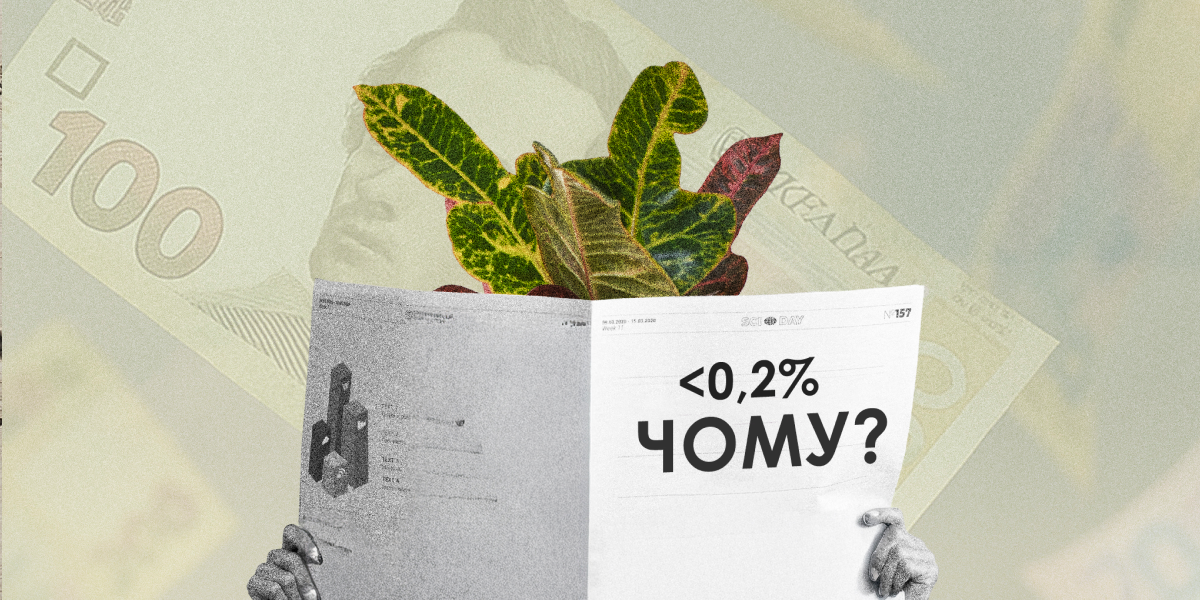
Why did less than 0.2% of the 29,000 Ukrainian grants go toward environmental protection?


The Glossary Eco Foundation analyzed the possibilities for obtaining government funding for environmental projects in Ukraine. The results were unexpectedly grim, but important for understanding the true state of the country’s “green” economy.
Between 2022 and 2025, government grant programs awarded:
- 29,156 grants totaling 11.4 billion UAH
- Created 52,000+ jobs
- Grant recipients paid 7.0 billion UAH in taxes
It would seem to be a success story. But where are the environmental projects?
Among the thousands of grants awarded, there are no public examples of plastic recycling, organic waste composting projects, or circular economy initiatives.
There are no specific priorities or preferential terms for environmental projects.
According to our estimates, environmental projects account for less than 0.2% of the total number of grants.
Why did this happen? We see three levels of barriers.
The Math Doesn’t Add Up
The “Grants for Recycling Enterprises” program (up to 8 million UAH) formally allows for environmental projects. However, the grant conditions stipulate:
- Create 5 jobs (formally)
- Return 8 million UAH through taxes over 3 years
In reality, 5 employees earning 20,000 UAH per month generate about 2 million UAH in taxes over 3 years—that’s no more than 25% of the required amount. Therefore, to meet the grant requirements, you actually need 25–30 employees (not 5!), a turnover of 50–60 million UAH over 3 years, and a margin of at least 30%. This is extremely difficult to achieve even for an established small business, and for eco-projects it is critically difficult due to:
- Higher production costs (+30–50%)
- A small domestic market
- Lower profitability (15–25% versus 30–35% in traditional businesses)
Even the ideal scenario for an eco-project doesn’t work
Let’s take plastic recycling as an example. Minimum investment: 3–4 million UAH for equipment. With a turnover of 30 million UAH/year and a 30% margin:
Income tax over 3 years: 4,860,000 UAH
Taxes for 25 employees: 3,240,000 UAH
Total: 8,100,000 UAH ✓
It seems to add up, right? But the reality is:
No separate collection system → raw material collection costs +70%
The actual margin is not 30%, but 15–20%
Difficulties with selling the granules
Actual tax shortfall—up to 3 million UAH
Military context: the unpredictability factor
Mobilization (of the owner or key employees) can happen at any time
Frontline territories have preferential terms (80/20), but the risks are highest there
The energy crisis adds 15–25% to production costs
Population outflow leads to a decrease in demand for premium goods
According to unofficial data, 27–33% of grant recipients partially return funds to the state without fulfilling the conditions. For eco-projects, this percentage is likely even higher.
The only exception: biofuels
The production of pellets and briquettes is the only eco-friendly sector that can realistically secure government grants. Why?
A clear business model and stable demand
A margin of 25–35%
The ability to achieve the necessary revenue
There are precedents for successful projects
A critical condition: it’s better to already have an established woodworking business.
The paradox of the Ukrainian situation is that, officially, Ukraine is moving toward the EU, and the green economy is a priority. In reality, however, the largest business support programs effectively exclude environmental projects. This is due to:
A lack of specific priorities
Unreasonable financial conditions
A focus solely on economic indicators, without considering environmental impacts
What needs to change?
In order to truly follow a European course, the government must create a separate category of “green” grants with preferential terms. At a minimum:
- Reduce tax requirements for eco-projects to 70%
- Extend the payback period to 5–7 years
- Award bonus points for environmental impact during project selection
The government has already demonstrated its ability to adapt: In 2024, following many unsuccessful cases, the requirements were revised—from 25 jobs to 5; the job creation requirement was waived for young people under 25; and the implementation period was extended to 7 years for veterans.
Therefore, entrepreneurs, on the one hand, should expect similar changes for the eco-sector, and on the other hand, should not rely exclusively on government grants: they should utilize international programs (UNIDO, EU4Business), initially launch their model using their own funds, and be sure to account for military risks.
We are not writing this to criticize. Government grant programs are a real achievement that has helped tens of thousands of entrepreneurs. But if Ukraine is serious about green recovery and European integration, the system needs to adapt.
The recovery period offers a unique opportunity to build “green” from the start. But this requires not just declarations, but concrete support tools.
What has been your experience? Have you faced challenges when seeking funding for environmental initiatives? What support tools do you think would be most effective?
Support Glossary Eco Foundation so we can continue educational and eco-friendly projects that make real difference
Donate