


01
Initial request
The school administration or community representative contacts the foundation and briefly describes the situation.
School Under the Sun Program · Scaling
Monastyryska School answered the question about solar power plants on school roofs - 'does it work?'. Now the question is different: how quickly, and to how many schools, this can be extended. The answer is specific and measurable. By the end of 2028, the Foundation will deliver the programme in 15 schools across Ukraine.
This is not a theoretical aim - behind each figure lies a logic: the technical solution is unified and reproducible, the financial model is transparent, and the organisational mechanism has been proven on the pilot. Each subsequent school follows the same path - from energy audit to launch - but faster, because it builds on the documented experience of the previous one.
15 schools means more than 4,500 children for whom the learning process ceases to depend on the state of the external grid. It means at least UAH 3.75 million freed up from utility payments each year - funds that remain in local budgets and return to education. And it means 225 tonnes of CO₂ reduction a year - a contribution that constantly accumulates.
At present, six schools have signed memoranda of cooperation with the Foundation. The Foundation initiates contact or considers a school's request, after which a working meeting takes place with the administration and representatives of the community. The discussion covers the real need for energy autonomy, the technical characteristics of the building, and the community's readiness for a long-term partnership.
The memorandum is signed when all parties understand and accept their commitments - the Foundation provides financing and installation, and the community and administration take on responsibility for subsequent operation and the educational component. Signing the memorandum is the first step of the cycle. It is followed by the energy audit, fundraising, equipment supply and installation. Until the plant is launched, the school remains at the preparation stage. This approach ensures the quality of the result: not one of the plants will be left without servicing, and not one educational component will turn into a formal process.
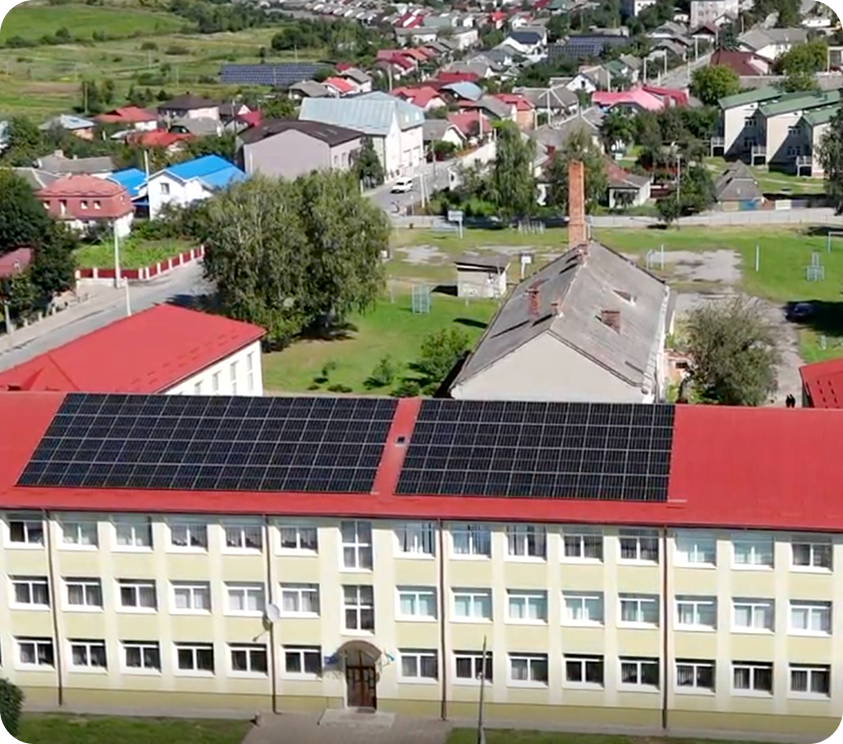
The 'School Under the Sun' programme is open to schools across Ukraine. The two key selection criteria are a real need for energy autonomy and the readiness of the administration and the local community for partnership.
The school administration or community representative contacts the foundation and briefly describes the situation.
The foundation organizes a technical inspection of the building, roof, electricity consumption and grid condition.
The document records the obligations of the foundation, community and school administration.
Technical solutions are prepared, equipment is purchased and installation work is planned.
The installation team mounts the station, connects the system and tests it.
The school receives materials that explain renewable energy principles to students.
Write to us, and we will conduct an initial assessment and explain where to start.
The standard configuration is designed for a school of 200-400 pupils and provides full coverage of backup-power needs during outages and a substantial reduction of electricity costs throughout the year.
| Item | Model | Quantity |
|---|---|---|
| Photovoltaic module | Tier 1 (model selected by tender) | 48 units |
| Hybrid inverter | Tier 1, hybrid (model selected by tender) | 1 unit |
| Battery system | LiFePO₄, Tier 1 (model selected by tender) | 1 set |
| Indicator | Value |
|---|---|
| Design capacity (by PV modules) | 28.56 kW |
| Inverter power | 20 kW |
| Total storage capacity | 46 kWh |
| Projected annual volume | 28,560 kWh |
| Service life | 25 years |
The amount includes equipment, installation work, technical support and system launch.
A donor supports a specific school and sees the result: an installed station, reports, photos, financial confirmation and long-term social impact.
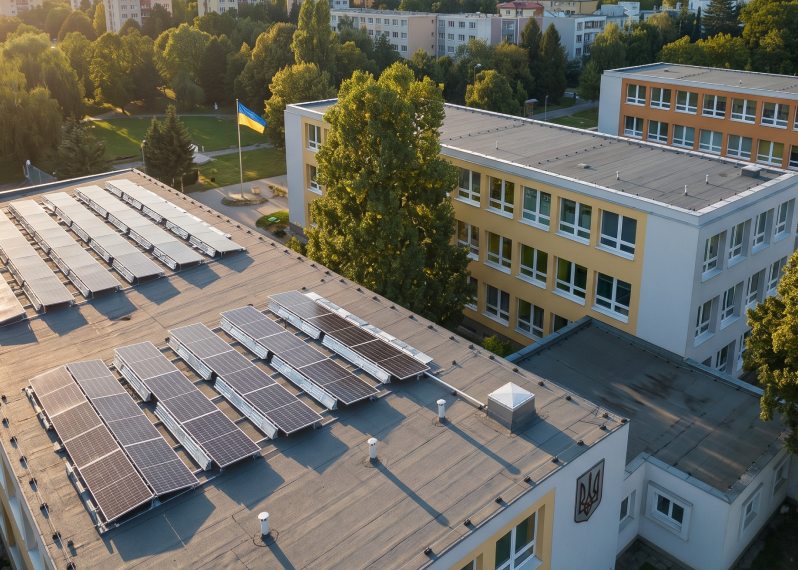
ESG confirmation in a format compatible with CSRD and GRI standards.
| Year | Number of schools | Cumulative total |
|---|---|---|
| 2026 | 4 schools | 4 schools |
| 2027 | 7 schools | 11 schools |
| 2028 | 4 schools | 15 schools |