


Learning without interruptions
Infrastructure + Education
We combine technological solutions with environmental thinking formed from childhood.
The sun gives energy, and we give children the opportunity to keep learning. Discover how schools become autonomous through the project.
Anastasiia Tsybuliak, founder of the foundation
““When a school works even during a blackout, it is more than light in a classroom. It is a signal to children: solutions exist, they are real, and they can be built with one's own hands.”


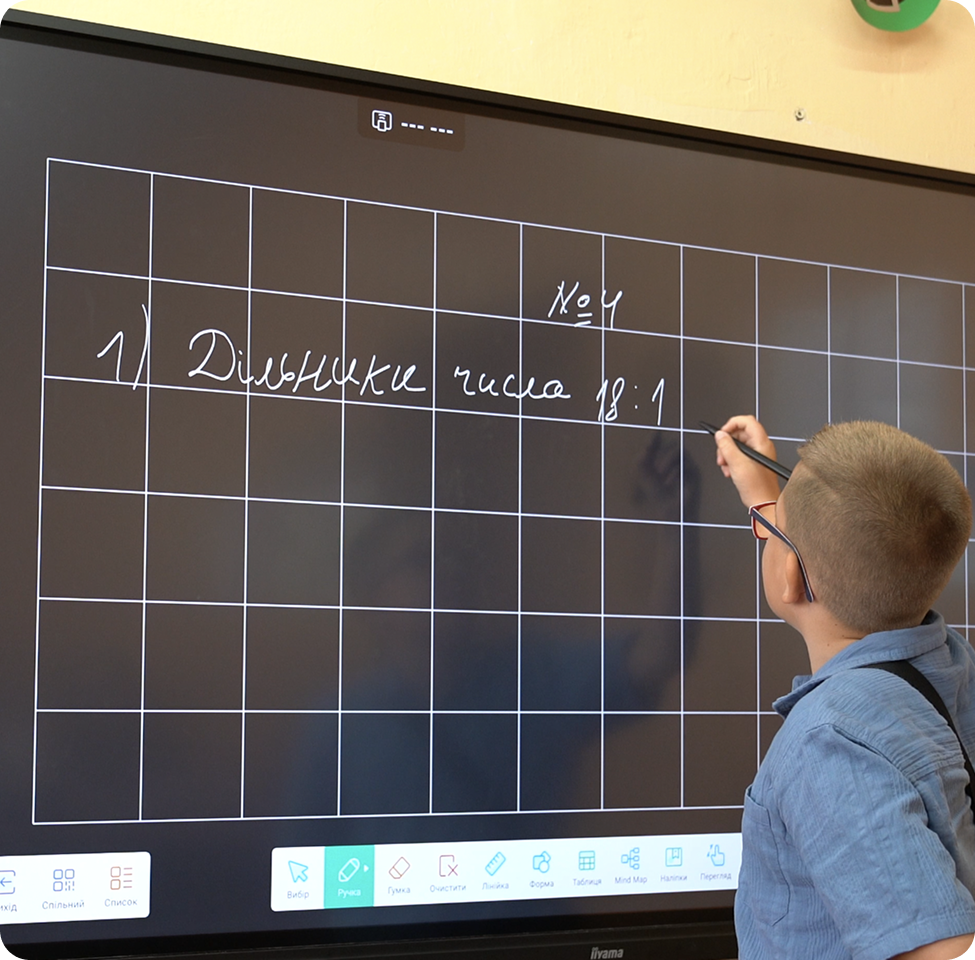
What a school receives through the project
A hybrid solar power plant with a capacity of 20-30 kW and an energy storage system. The system operates in three modes - from the sun, from the grid and from the battery - and covers a typical blackout of up to 6 hours: this is enough for the school to work a full school day even during outages. Capacity is selected individually: up to 30 kW is a typical configuration for schools of 200-400 pupils; the pilot project at the school in the town of Monastyryska was delivered with a capacity of 51.5 kW, in view of the size of the institution.
A solar power plant makes it possible to cover up to 20-50% of annual electricity consumption, generating substantial annual cost savings - hundreds of thousands of hryvnias that can be directed to the development of education. The service life of the plant is 25 years: this is a long-term investment, not a one-off form of aid.
A reduction of CO₂ emissions by 15 tonnes a year - equivalent to the annual absorption of around 800 trees. Over the service life of the plant, a single school ensures the avoidance of more than 375 tonnes of CO₂.
We combine technological solutions with environmental thinking formed from childhood.
Funding, engineering expertise, community support and business partnerships.
Energy audits, design, installation of solar stations, integration into school networks and development of educational programs.
Continuous learning, cost savings, lower CO₂ emissions and practical experience with sustainable solutions.
A pupil who, in a physics lesson, analysed real data from the panels on the roof of their own school perceives renewable energy differently - as a specialist, a consumer and a citizen. Schools become centres of sustainable development in their communities, and the proven model lays the groundwork for systemic scaling - whether by the state or by business - once public demand reaches a critical mass.
Transparent data on cost savings, CO₂ reduction and the number of children and communities that have benefited from the project. Online monitoring of the plant makes it possible to see generation figures in real time.
The project may carry the donor’s name in public communications and school information materials.
Regular photo and video reports, open financial data, and ongoing communication about the stages of project delivery. All funds are directed to the procurement and installation of photovoltaic panels, inverters, energy storage systems, installation services and logistics - no hidden items.
Full financing of a standard project for one school is around USD 30,000. This is the standard set of equipment for a 28-30 kW system, covering the needs of a school of 200-400 pupils: photovoltaic panels, an inverter, an energy storage system, installation and logistics. For larger schools, the configuration and accordingly the cost increase proportionally - in the pilot project at Monastyryska School (638 pupils, 51.5 kW), the delivered cost amounted to USD 42,000.
The contribution is integrated into corporate sustainability reporting, strengthening the company's ESG position. Unlike forest offsets, where emissions reduction is built on hypothetical scenarios, a school solar plant with online monitoring generates verified data in real time: kilowatt-hours, CO₂, operating periods. The 'School Under the Sun' project provides a format of confirmation in line with the CSRD and GRI standards.
Coverage in Ukrainian and international media, raising brand recognition and reputational capital.
An investment that works for 25 years, supporting the stability of communities and changing children's attitudes to energy and the environment. Real savings, verified CO₂ reduction and stable education.