Ukrainian Media Cover Glossary Eco Foundation’s Nationwide School Under the Sun Project


TSN
The first energy-independent school supported by Glossary Eco Foundation has appeared in Ukraine. Glossary Eco Foundation implemented the first project within the School Under the Sun program: in Monastyryska, Ternopil region, a school began operating that fully provides itself with electricity thanks to solar panels. The 20-50 kW station makes it possible to keep the educational process uninterrupted, save local budget funds and reduce CO₂ emissions by up to 50 tons annually.
Founder of Glossary Eco Foundation Anastasiia Tsybuliak emphasizes: “School energy independence is not simply a technology. It is a guarantee that a child will have lessons, warmth and internet access in any situation.” She notes that more than 5 million children have lost stable access to education because of the war, while autonomous schools can minimize these losses.
The project will also introduce an educational module on renewable energy: children will study how solar generation works and how it can serve a community. “When a student sees that the school produces its own energy, they perceive resilience and responsibility differently. This is a new culture,” Tsybuliak adds.
Glossary Eco Foundation stresses that scaling the program can bring the country a significant economic effect: 50 schools mean more than UAH 25 million in savings per year, and 500 schools mean more than UAH 250 million. The Foundation calls on businesses, patrons and international organizations to join the project. In Ukraine, every school can become energy-independent.
DZERKALO TYZHNIA (ZN)
Anastasiia Tsybuliak: “The energy independence of Ukrainian schools is an act of national agency.”
Glossary Eco Foundation announced the launch of one of the country’s most ambitious educational and energy programs: School Under the Sun, which is intended to transform Ukrainian schools into fully autonomous centers of resilience. The first pilot project was launched in Monastyryska, Ternopil region: the school roof was covered with solar panels that ensure uninterrupted operation even during long blackouts, which have become part of wartime everyday life. For the community, this is not merely a technical solution; it is a symbol of the ability to take responsibility for its own future. The Foundation’s founder, Doctor of Economic Sciences and Candidate of Political Sciences Anastasiia Tsybuliak, calls this step “an example of how a community moves from waiting for help to creating infrastructure that does not need external support to survive.”
Over two years of war, more than five million children have lost stable access to education. Power interruptions have led to the loss of hundreds of learning hours each month, reduced motivation, psychological exhaustion and the destruction of the educational rhythm. In these conditions, a school that works independently of the country’s energy situation becomes not only an object of social support, but a basic element of national security. “Light in a school is more than lighting. It is a signal to a child that the country remembers them. It is proof that even in dark times we are capable of creating points of stability,” Tsybuliak says.
The School Under the Sun project combines technological engineering, educational reform and economic rationality. Solar power plants with a capacity of 20-50 kW provide 100% autonomy for a school during critical periods, reduce CO₂ emissions by up to 50 tons per year and save about half a million hryvnias annually. In addition, surplus energy can be sold under the green tariff, turning the school from a budget-dependent consumer into an energy producer capable of financing its own needs. According to model calculations, scaling the project to 50 schools will bring more than UAH 25 million in annual savings, while implementation in 500 schools will bring more than UAH 250 million.
Alongside the technical equipment, Glossary Eco Foundation will introduce an educational module on renewable energy, enabling children not only to use stable internet and warmth, but also to understand how technologies change communities and the country. “We are forming a generation that grows up with the awareness that energy independence is not about the state of networks; it is about the state of thinking,” the founder of Glossary Eco Foundation emphasizes.
Anastasiia Tsybuliak stresses that the main goal of the program is to create a standardized model of energy autonomy that any community can adopt. Every school in Ukraine has the potential to become energy-independent. “This is not about technology; it is about agency. When a school generates its own energy, it stops being hostage to circumstances. And together with it, the community also stops being hostage,” she summarizes.
Glossary Eco Foundation calls on businesses, donors and international organizations to join the scaling of School Under the Sun. The Foundation views this project as the foundation of a new culture of responsibility, where education, technology and ecology work as a single system for the benefit of Ukrainian children and the state being rebuilt.
OBOZREVATEL
The first energy-independent school has started operating in Ternopil region: Glossary Eco Foundation launches the nationwide School Under the Sun program.
In Monastyryska, Ternopil region, the first school that fully provides itself with electricity thanks to solar panels has started operating. This is the launch of the large-scale School Under the Sun program implemented by Glossary Eco Foundation. Its goal is to create a network of energy-independent educational institutions able to operate without interruptions even during long blackouts. The school roof was covered with 20-50 kW solar panels that provide light, internet, warmth and stability for the educational process.
The Foundation’s founder, Anastasiia Tsybuliak, explains that the idea emerged as a response to the large-scale educational losses caused by the war. “We saw how many children found themselves in a situation where a lesson could disappear together with the light. That is why we created a model in which a school has its own energy resilience and does not depend on external risks,” she says. According to her, the autonomy of the learning environment is one of the key factors in children’s psychological stability.
The pilot project not only provides the school with electricity, but also has a significant economic effect: up to UAH 500,000 in annual savings, a reduction of CO₂ emissions by dozens of tons and the possibility of selling surplus energy under the green tariff. Glossary Eco Foundation emphasizes that this model can be implemented in any Ukrainian community. “This is not simply about electricity; it is about forming a new type of thinking in which responsibility and technology go hand in hand,” Tsybuliak adds.
Glossary Eco Foundation plans to scale School Under the Sun in 2025 and invites companies, international organizations and patrons to join the financing of new schools. In Ukraine, every educational institution can receive energy autonomy and stability under any conditions.
UNIAN
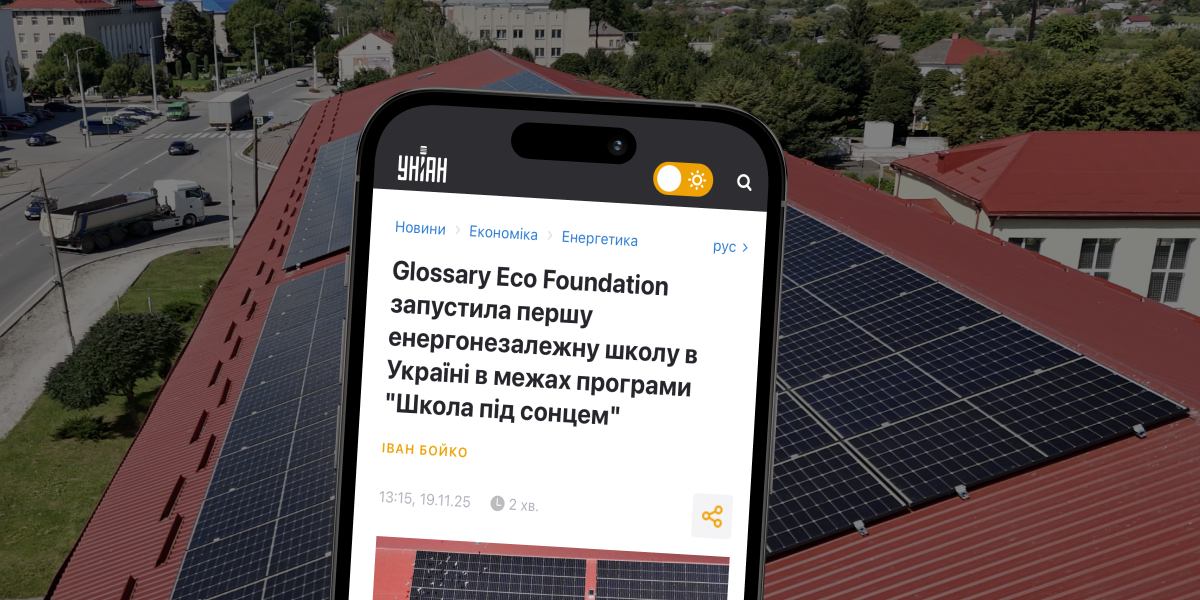
Glossary Eco Foundation has launched the first energy-independent school in Ukraine within the School Under the Sun program.
Glossary Eco Foundation announced the launch of the first energy-independent school in Ukraine within the national School Under the Sun program. The project was implemented in the town of Monastyryska, Ternopil region. The roof of the educational institution was equipped with a 20-50 kW solar power plant that ensures uninterrupted school operation during power outages.
According to the Foundation, the system guarantees the educational process in full autonomy mode, including lighting, internet access and equipment operation. Expected savings amount to up to UAH 500,000 annually. The project also provides for a reduction in CO₂ emissions of up to 35-50 tons per year.
The School Under the Sun program focuses on creating a model of energy resilience for Ukrainian educational institutions. Glossary Eco Foundation notes that, with proper financing, every school in Ukraine can be transferred to partial or full energy autonomy.
Founder of Glossary Eco Foundation Anastasiia Tsybuliak emphasized that the project is practical and long-term in nature. “When a school operates independently of the external energy system, it guarantees children’s stable access to learning during crisis situations,” she said.
At the same time, the initiative includes an educational component: students will be offered a basic course on renewable energy aimed at forming a practical understanding of how solar systems work. Glossary Eco Foundation plans to scale the program in 2025 and is considering opportunities to attract partner financing from businesses, international donors and communities.
FOCUS
Glossary Eco Foundation launches a large-scale program of energy-independent schools: how School Under the Sun is shaping a new standard of Ukrainian resilience.
Glossary Eco Foundation presented one of the largest initiatives in the post-war rebuilding of education: the School Under the Sun program. The first project was implemented in Monastyryska, Ternopil region, where the school received a full-fledged solar power plant and became energy-autonomous even during long blackouts.
The initiative has an ambitious goal: to change the infrastructural logic of Ukrainian schools by turning them into resilient energy-generating centers. At a time when the education system is facing some of the greatest challenges in its history, autonomous schools are becoming part of the national mechanism of endurance.
Founder of Glossary Eco Foundation Anastasiia Tsybuliak explains: “We wanted to show that light can be constant even in dark times. When a child comes to school and knows there will be warmth, light and internet there, we are not simply generating energy; we are generating faith.”
Solar panels with a capacity of 20-50 kW provide the school with full autonomy during critical periods, reduce CO₂ emissions and save up to UAH 500,000 annually. Surplus energy can be sold under the green tariff, creating an additional resource for infrastructure development.
The program also includes an educational module on renewable energy. Children see a real, not theoretical, energy system working for the benefit of the community. This forms a generation that understands the principles of energy independence as an element of culture, not as a temporary solution.
Glossary Eco Foundation’s economic models demonstrate the potential scale: implementing the project in 50 schools will provide UAH 25 million in savings and hundreds of tons of reduced emissions. Scaling it to 500 institutions will turn energy independence into a new standard for Ukrainian education.
“The future is not a date on a calendar; it is the consequence of the decisions we make today. We want no school in Ukraine to remain in darkness,” Tsybuliak adds.
Glossary Eco Foundation calls on businesses, international organizations and patrons to join the program. According to the Foundation, the Ukrainian education system has the potential to become one of the most resilient in Europe if energy autonomy becomes its basic characteristic.
PODROBNOSTI
How the Glossary Eco Foundation School Under the Sun project is changing Ukrainian communities.
In Ternopil region, a school has started operating on solar energy: a Glossary Eco Foundation project that can significantly change how communities live through war and rebuilding. The roof of the educational institution is covered with solar panels that ensure the school’s operation regardless of external energy conditions.
Founder of Glossary Eco Foundation Anastasiia Tsybuliak emphasizes: “Energy is not only about electricity. It is about dignity, confidence and a child’s right to learn regardless of circumstances.” Her approach combines energy engineering, social sustainability and educational transformation.
During the full-scale war, millions of children have lost stable access to education. Blackouts have become a threat not only to comfortable learning, but to the very possibility of continuing the educational process. In this reality, a school able to operate without the power grid becomes not an innovation, but a necessity.
The School Under the Sun project equips institutions with 20-50 kW solar power plants that make it possible to generate energy, save up to half a million hryvnias and significantly reduce CO₂ emissions. Children see the real operation of a system that produces energy for their learning, and this changes their picture of the world.
The school becomes a community center that guarantees stability even during long outages. This creates a new model of interaction between the community and infrastructure, where people see their own contribution to the resilience of their territory.
According to the Foundation’s estimates, if 500 schools switch to solar generation, Ukraine will be able to save hundreds of millions per year and reduce CO₂ emissions by tens of thousands of tons. This is not simply about electricity; it is about a new social architecture based on autonomy and responsibility.
Comments.ua
Glossary Eco Foundation launches School Under the Sun: how energy autonomy is becoming part of a new Ukrainian culture.
In Monastyryska, Ternopil region, an event took place that may have a much broader impact than it seems at first glance: a school became fully energy-independent thanks to solar panels. This is the first step of the large School Under the Sun program initiated by Glossary Eco Foundation.
The Foundation’s founder, Anastasiia Tsybuliak, formulates the idea as follows: “A child who studies under light powered by the energy of the sun receives not only knowledge, but also experience.” This thesis reflects the organization’s approach: technology becomes an instrument of cultural change.
The program provides for equipping schools with solar stations that guarantee stable learning even in the most difficult conditions. It responds to the key problem of the war: the loss of access to education because of power interruptions. Stations with a capacity of 20-50 kW provide autonomy, budget savings and a reduction in CO₂ emissions, while also forming in children a practical understanding of environmental technologies.
The potential scale of the effect is enormous. If even 10% of Ukrainian schools switch to similar solutions, this will create one of the largest community-managed educational energy networks in Europe.
“We are building not a system of panels, but a culture of light. And I want this culture to become a new language of Ukraine,” Tsybuliak says. Glossary Eco Foundation views the project as a long-term investment in the country’s recovery through education, energy and ecology.
Support Glossary Eco Foundation so we can continue educational and eco-friendly projects that make real difference
Donate